

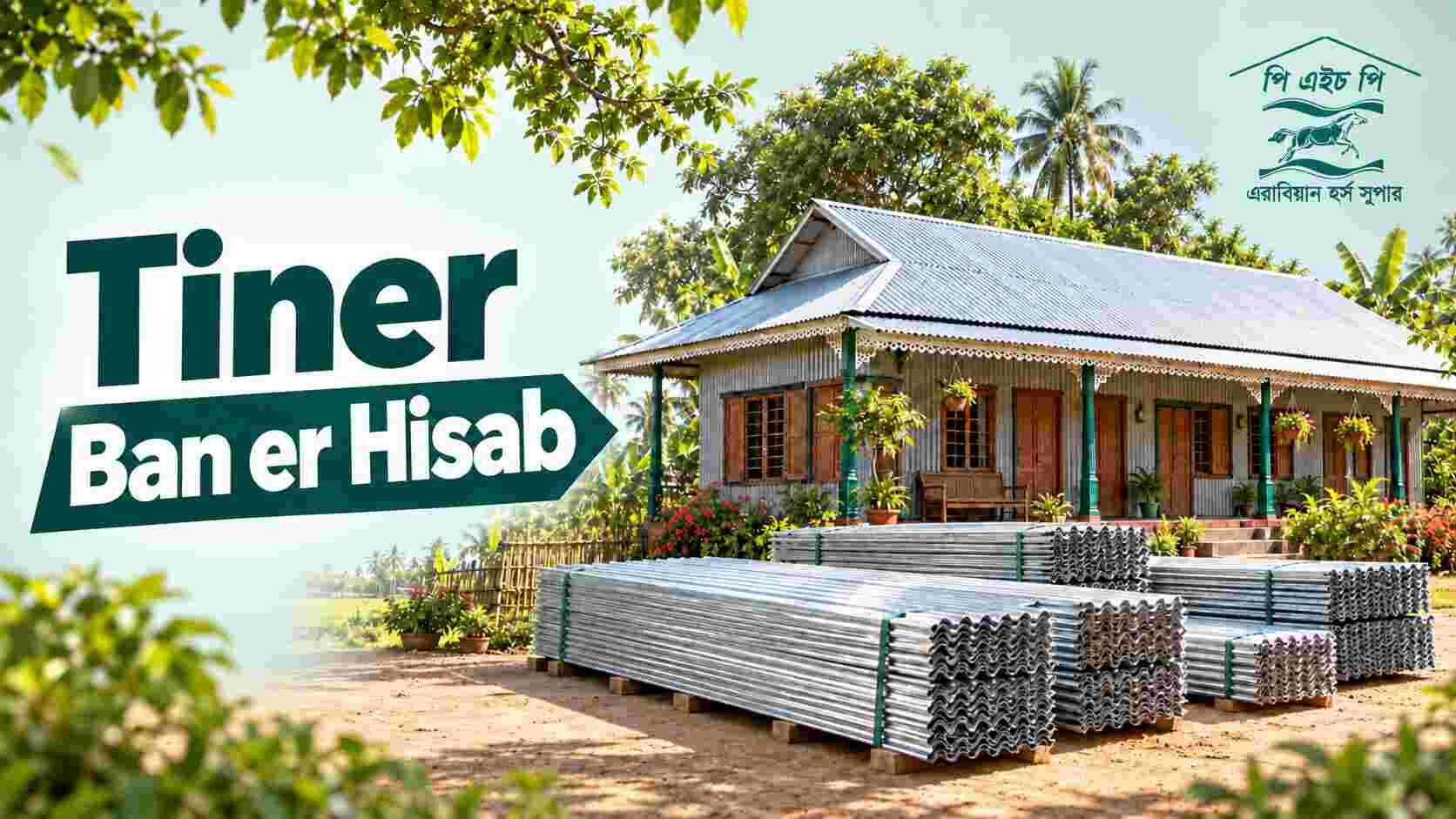
Building a new house, replacing an old roof, or constructing a shop or garage often raises an important question: how many bundles of roofing tin will be required? When purchasing roofing sheets, you may come across different lengths, such as 6 feet, 7 feet, 8 feet, or 10 feet. However, not everyone knows how many sheets are included in a bundle for each size.
Without understanding tiner ban er hisab, you may end up purchasing more or fewer roofing sheets than necessary. This can increase construction costs or cause unnecessary delays. Therefore, before installing a roof, it is important to calculate the number of bundles, measure the roof properly, and determine the required number of sheets.
In this article, we will explain tiner hisab through simple examples, including how many sheets are included in one bundle, how roofing tin is calculated, and how many bundles may be required for a house.
What Is a Tin Bundle and How Many Feet of Tin Does It Contain?
A tin bundle refers to a group of roofing sheets packed together in a specific quantity. In Bangladesh, corrugated roofing sheets are commonly measured and sold by individual pieces as well as bundles.
The number of sheets in one bundle mainly depends on the length of each sheet and the supplier’s packaging system. For example, a bundle of 6-foot roofing sheets does not necessarily contain the same number of pieces as a bundle of 7-foot or 10-foot sheets.
When understanding tiner ban er hisab, it is important to remember that all bundles do not contain an equal number of sheets. Similarly, it is incorrect to assume that every bundle contains exactly 72 feet of roofing sheets.
For Example:
12 pieces of 6-foot tin = 72 feet.
10 pieces of 7-foot tin = 70 feet.
This means the total combined length of sheets in a bundle may be 70 feet or 72 feet, depending on the sheet length. However, these are not mandatory packaging standards followed by every manufacturer or supplier.
Easy Rules for Calculating Tiner Ban Er Hisab
To calculate the number of roofing sheets in a bundle, you first need to know the total combined sheet length included in that bundle. Then, divide the total length by the length of an individual sheet.
Formula for Calculating Tiner Ban Er Hisab
Number of sheets in one bundle = Total sheet length in the bundle ÷ Length of each sheet
Suppose you want to purchase 6-foot corrugated roofing sheets. The supplier informs you that one bundle contains a total sheet length of 72 feet.
The calculation will be: 72 ÷ 6 = 12 pieces. This means one bundle contains 12 pieces of 6-foot roofing sheets in this example.
Similarly, if a bundle contains 10 pieces of 7-foot roofing sheets, its total combined length will be: 7 × 10 = 70 feet.
By following this tin er hisab method, you can easily verify how many roofing sheets you should receive from the supplier.
However, if dividing 70 or 72 by a particular sheet length produces a fractional result, you cannot directly treat that result as the number of complete sheets in a bundle. Roofing sheets are generally supplied as whole pieces.
Calculation of 70-Foot and 72-Foot Tin Bundles
The calculation of roofing sheet bundles can be understood using examples based on total sheet lengths of 70 feet and 72 feet.
If a 70-foot bundle contains 7-foot roofing sheets, it will have 10 pieces. On the other hand, if a 72-foot bundle contains 6-foot roofing sheets, it will have 12 pieces.
The important point is that you should not calculate the quantity based only on the bundle name. Before purchasing, confirm the length of each sheet and the actual number of pieces included in the bundle.
How Many Tin Sheets Are There in One Bundle?
This is one of the most common questions among people purchasing roofing sheets. However, the answer is not the same for every sheet length. The following table shows examples for 6-foot and 7-foot sheets, along with illustrative calculations for other lengths.
Tiner Ban Er Hisab: Number of Sheets Based on Length
| Tin Sheet Length | Pieces per Bundle | Total Length |
|---|---|---|
| 6 feet | 12 pieces | 72 feet |
| 7 feet | 10 pieces | 70 feet |
| 8 feet | 9 pieces (example) | 72 feet |
| 9 feet | 8 pieces (example) | 72 feet |
| 10 feet | 7 pieces (example) | 70 feet |
| 12 feet | 6 pieces (example) | 72 feet |
Rules and Essential Formulas for Tin Er Hisab
Before purchasing roofing sheets for a house, knowing the number of pieces in one bundle is not enough. You must also calculate how many sheets are needed to cover the entire roof.
For accurate tin er hisab, it is important to know the roof measurements, the length of the roofing sheets, and their effective width. Effective width refers to the portion of a sheet that actually covers the roof after two adjacent sheets are installed with the required overlap.
How to Measure Roof Length and Width for Tiner Hisab
First, measure the section of the roof where the roofing sheets will be installed. You need to know the length along the roof and the length of the roof slope.
The measurement along the roof helps determine how many sheets need to be placed side by side. The slope measurement helps determine the required length of each roofing sheet.
For example, suppose the length along the roof is 30 feet and the effective width of each sheet is 2.5 feet.
The tiner hisab will be: 30 ÷ 2.5 = 12 pieces.
This means a total of 12 roofing sheets will be required in one row, provided each sheet is long enough to cover the entire roof slope. However, the effective width of 2.5 feet is used here only as an example. The actual effective width may vary depending on the type and size of the roofing sheet.
Therefore, before calculating the required quantity, confirm the effective width of your selected roofing sheets with the supplier.
Practical Example of Calculating Tin Er Hisab
Suppose you need 18 roofing sheets, each measuring 8 feet in length, to cover a section of your house roof. The supplier informs you that one bundle contains 9 pieces of 8-foot roofing sheets.
To calculate the required number of bundles, divide the total number of sheets needed by the number of sheets in each bundle. Calculation: 18 ÷ 9 = 2 bundles. This means you will need 2 bundles of roofing sheets to cover that section of the roof.
In this way, you should first determine the total number of sheets required based on the roof measurements. Then, find out how many pieces are included in one bundle to calculate the total number of bundles needed.
However, the number of sheets per bundle may vary depending on the sheet length and the supplier’s packaging system. Always confirm the correct quantity before purchasing.
You should also consider cutting waste and the possible need for additional sheets. This will help make your tiner hisab more accurate and reduce unnecessary expenses.
How Is Tin Er Hisab Calculated? Step-by-Step Guide
Many people want to know how tin er hisab is calculated and how to determine the total number of sheets or bundles required based on the measurements of a house roof.
To calculate correctly, you need to know the roof dimensions, roofing sheet length, effective width, and number of sheets per bundle. By following a few simple steps, you can estimate the required quantity of roofing sheets.
How to Calculate Tiner Hisab in 5 Easy Steps
1. Measure the Roof Accurately
The first step in calculating roofing tin requirements is to measure the roof properly. You need to measure the length along the roof and the length of each roof slope separately.
For a single-slope roof, you only need to calculate one slope. However, for a double-slope roof, both slopes should be measured separately because their dimensions may differ. Accurate measurements make it easier to determine the number of roofing sheets required.
2. Determine the Required Roofing Sheet Length
After measuring the roof, decide what length of roofing sheets you will use. Generally, the length of the sheets is selected according to the roof slope. For example, if the roof slope is 8 feet long, you must also consider any additional length required for the eaves.
Some extra sheet length may be necessary to allow rainwater to flow away from the roof. Therefore, select the appropriate roofing sheet length based on the complete slope measurement before purchasing.
3. Know the Effective Width of the Roofing Sheets
The total width and effective width of a roofing sheet may not be the same. This is because adjacent sheets overlap during installation. As a result, the entire width of each sheet cannot be used to cover the roof.
For example, if a roofing sheet has an effective width of 2.5 feet, that measurement should be used when calculating the required quantity. For accurate tin er hisab, confirm the effective width of the selected roofing sheet with the supplier.
4. Calculate the Total Number of Roofing Sheets
Once you know the roof measurements and the effective width of the roofing sheets, calculate the total number of sheets required. To do this, divide the length along the roof by the effective width of one sheet.
Suppose the length along the roof is 30 feet and the effective width of each sheet is 2.5 feet. Calculation: 30 ÷ 2.5 = 12 pieces. This calculation applies to one roof slope, provided each sheet covers the full length of that slope.
For a double-slope roof, calculate the other slope in the same way and add the required number of sheets together. If the result is a fraction, round it up to the next whole number.
5. Convert the Total Number of Sheets into Bundles
Finally, calculate how many bundles you need to purchase based on the total number of roofing sheets required. For this calculation, you must know how many pieces are included in one bundle.
Suppose your roof requires 18 pieces of 8-foot roofing sheets, and each bundle contains 9 pieces. Calculation: 18 ÷ 9 = 2 bundles. However, the number of pieces per bundle may not always be the same. Confirm the correct quantity with the supplier before making your calculation.
If the required number of bundles is not a whole number and the supplier sells only complete bundles, round up to the next whole bundle. By following these five steps, you can easily understand how tiner hisab is calculated. You can also determine the total number of sheets and bundles required for your house roof.
This makes it easier to plan your roofing budget and reduces the risk of purchasing unnecessary materials.
How Many Bundles of Tin Are Needed for a House Roof?
The number of bundles required for a house roof depends on its shape, length, width, and slope. The dimensions of the roofing sheets also play an important role. When installing roofing sheets, you must consider the overlap between adjacent sheets and any additional length required at the eaves.
Therefore, knowing only the floor length and width of a house may not be enough to determine the exact quantity of roofing sheets required. First, measure each roof slope. Then, calculate the total number of sheets needed based on the length and effective width of the selected roofing sheets.
Finally, divide the total number of sheets by the number of pieces included in each bundle. Following this method provides a clearer idea of the roofing materials required and makes it easier to estimate costs before purchasing.
Tiner Hisab for a Single-Slope Roof
A single-slope roof generally slopes in one direction. For this reason, calculating the required number of roofing sheets is relatively straightforward. First, measure the length along the roof and the actual slope length. Then, determine how many roofing sheets are needed based on their effective width.
Suppose a single-slope roof has a length of 24 feet and the effective width of each roofing sheet is 2 feet. Calculation: 24 ÷ 2 = 12 pieces. This means the roof will require 12 roofing sheets, provided each sheet is long enough to cover the entire slope.
Next, determine how many bundles must be purchased. For this, confirm the number of sheets included in each bundle of the selected length. For example, if each bundle contains 6 pieces, the tiner ban er hisab will be: 12 ÷ 6 = 2 bundles.
Therefore, in this example, 2 bundles of roofing sheets will be required to cover the single-slope roof. However, the required quantity may vary depending on sheet length, overlaps, and additional length needed at the eaves. For this reason, it is always better to calculate the quantity using the actual roof measurements before purchasing.
Tiner Hisab for a Double-Slope Roof
A double-slope roof has two sloping sections. Therefore, the measurements of both slopes must be considered when calculating the required roofing sheets. If both slopes have the same dimensions, multiply the number of sheets required for one slope by two to determine the total quantity.
However, if the two slopes have different dimensions, each section must be calculated separately.
How Many Bundles of Tin Are Required for a 20 × 30 Feet House?
Suppose a house is 30 feet long and 20 feet wide, with two equally sized roof slopes. For this example, assume that 12-foot roofing sheets are sufficient to cover the entire length of each slope, each sheet has an effective width of 2.5 feet, and every bundle contains 6 pieces.
First, calculate the number of sheets required for one slope: 30 ÷ 2.5 = 12 pieces.
For both slopes, the total number of sheets will be: 12 × 2 = 24 pieces.
Now, if each bundle contains 6 sheets, the tiner ban er hisab will be: 24 ÷ 6 = 4 bundles.
This means the house will require a total of 4 bundles of roofing sheets under the assumptions used in this example.
However, the actual quantity may vary depending on the roof slope, eaves, sheet overlaps, and cutting requirements.
Therefore, for accurate tin er hisab, it is advisable to have the roof measurements checked by an experienced roofing installer before purchasing.
Things to Consider Before Buying Tin Bundles
Understanding tiner ban er hisab helps determine the number of roofing sheets required. However, a few additional factors should be considered before purchasing.
Check the Length and Width of Roofing Sheets
It is important to select roofing sheets with suitable dimensions for your house roof. Incorrect sheet dimensions may result in unnecessary cutting or the need to purchase additional materials.
To learn more about available sizes, read our guide on Corrugated Roofing Sheet Measurements.
Check Roofing Sheet Thickness and Quality
Even when roofing sheets have the same length, their thickness, weight, and protective coatings may differ. Therefore, instead of choosing roofing sheets based only on the number of bundles or a lower price, it is important to evaluate their quality.
For more information, read our article on How to Identify Good Quality Roofing Tin.
Consider Overlaps and Additional Roofing Sheets
When installing roofing sheets, portions of adjacent sheets must overlap. As a result, the entire width of each sheet cannot be used for roof coverage. Additional sheets may also be needed for roof corners, eaves, and cutting requirements.
Therefore, these factors should always be considered when calculating roofing sheet quantities.
Confirm the Number of Sheets per Bundle
Before purchasing, confirm the exact number of sheets included in each bundle with the supplier. The quantity may differ depending on the sheet length and packaging system.
Verifying this information makes tiner ban er hisab easier and helps reduce the possibility of buying too many or too few roofing sheets.
Frequently Asked Questions About Tiner Ban Er Hisab
How Many Pieces of Tin Are There in One Bundle?
The number of roofing sheets in one bundle depends on the sheet length and the supplier’s packaging system. For example, 12 pieces of 6-foot sheets have a total length of 72 feet, while 10 pieces of 7-foot sheets have a total length of 70 feet.
How Many Feet of Tin Are There in One Bundle?
A bundle does not always contain the same total sheet length. Examples include 70-foot and 72-foot bundle calculations.
However, always verify the actual number of pieces and total length of the selected product before purchasing.
How Many 8-Foot Tin Sheets Make One Bundle?
If a bundle contains 9 pieces of 8-foot roofing sheets, the total combined length will be 72 feet.
This is a mathematical example. The actual number of sheets may vary depending on the supplier’s packaging.
How Many 10-Foot Tin Sheets Make One Bundle?
Seven pieces of 10-foot roofing sheets have a combined length of 70 feet.
If a supplier packages the sheets in this way, one bundle will contain 7 pieces. However, this is not a fixed quantity for every brand.
How Is Tin Er Hisab Calculated for a House?
First, measure each roof slope. Then, calculate the required number of sheets based on the effective width of the selected roofing sheets.
Finally, divide the total number of sheets by the number of pieces included in each bundle to determine how many bundles are required.
Final Words
Understanding tiner ban er hisab before installing a roof makes it much easier to determine the required number of roofing sheets. Having a clear idea of each sheet’s length, the number of pieces per bundle, and the roof measurements can help avoid unnecessary expenses.
Therefore, before purchasing roofing sheets, understand how tin er hisab works and calculate the required quantity based on the actual measurements of your roof. Also, check the sheet thickness, effective width, quality, and product information provided by the supplier.
For information about suitable roofing sheet sizes, thickness, availability, and other product details for your house or project, contact PHP Arabian Horse Super.